Prime Minister Narendra Modi’s visits to Namibia and Ghana in July 2025, as part of a five-nation tour that also included Trinidad and Tobago, Argentina and Brazil, once again brought India–Africa economic relations into sharp focus—much like his visit to Ethiopia in December 2025. Over the past decade, India’s engagement with African nations has gained renewed momentum. A significant marker of this shift was the African Union’s inclusion as a permanent member of the G20 during India’s presidency in 2023. While India and Africa share deep-rooted cultural ties and a history of political solidarity, economic cooperation has increasingly become the cornerstone of their relationship.
Uncertainty in Western markets
In FY24, nearly 40% of India’s exports were directed to the United States and the European Union. With growing volatility in these markets and the risk of an economic slowdown, it has become imperative for India to diversify its export destinations—particularly towards African economies.
India currently ranks as Africa’s fourth-largest trading partner, with bilateral trade approaching $100 billion. In FY24 alone, India exported goods worth $38.17 billion to African countries, with Nigeria, South Africa and Tanzania emerging as key destinations. Major export items included petroleum products, engineering goods, pharmaceuticals, rice and textiles. In 2024, African imports from India accounted for about 6% of the continent’s total imports. By contrast, China—besides being a major investor—is Africa’s largest trading partner, with bilateral trade exceeding $200 billion. Roughly 21% of Africa’s imports in 2024 originated from China, with nearly one-third of these imports falling under HSN categories 84 and 85, highlighting China’s strength in machinery, electrical equipment and semiconductor-related industries.
Recognising this gap, India has set an ambitious goal of doubling its trade with Africa by 2030. Achieving this objective would require a focused five-point strategy.
The first pillar should centre on reducing trade barriers and pursuing preferential trade agreements and comprehensive economic partnership agreements with African regional blocs and key economies.
The second pillar must emphasise a shift from low-value commodity exports to value-added production through two-way trade and cross-border joint ventures. At present, Indian firms have not fully leveraged the incentives offered by several African governments for setting up manufacturing units. Establishing production facilities in Africa offers Indian companies a dual advantage: continued preferential access to the U.S. market through favourable tariff regimes and entry into Africa’s expanding consumer base and industrial demand. Moving beyond petroleum and traditional exports is essential for advancing India–Africa economic ties. Deeper engagement with regional frameworks such as the African Continental Free Trade Area (AfCFTA) could significantly expand opportunities for Indian exporters.
An opportunity for MSMEs
The third pillar should prioritise expanding Lines of Credit and improving access to trade finance. Africa presents significant opportunities for micro, small and medium enterprises (MSMEs), especially compared to the U.S. and European markets where entry barriers are high. However, policy support to help MSMEs access African markets remains inadequate.
Affordable and accessible trade finance is crucial for building a durable trade partnership with Africa. Measures such as promoting trade in local currencies and creating a joint insurance mechanism to cover political and commercial risks for medium-term projects could help lower perceived risks for MSMEs and financial institutions.
The fourth pillar should focus on reducing freight and logistics costs through investments in port modernisation, improved hinterland connectivity and the development of dedicated India–Africa maritime corridors.
The fifth and final pillar involves expanding services trade, digital commerce and people-to-people linkages. India must leverage its strengths in information technology, healthcare, professional services and skill development to boost services exports and, in turn, support goods trade. Services enable higher-value exports and facilitate deeper two-way economic engagement. Existing policy frameworks, however, remain insufficient to fully unlock services trade with African economies and require significant enhancement.
The role of the public sector
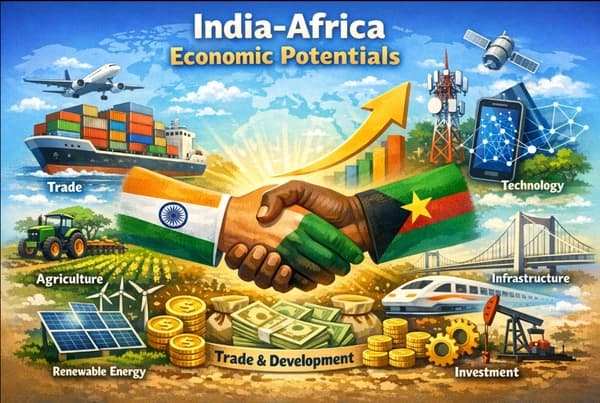
Greater investment by Indian companies in African manufacturing, agro-processing, infrastructure, renewable energy, and critical and emerging technologies would further strengthen bilateral ties. At present, India’s investment figures in Africa are skewed by flows routed through Mauritius, often driven by tax considerations. Bureaucratic challenges, political risks and high financing costs also discourage direct investment. Indian firms—particularly public sector enterprises—should take the lead in expanding investments across Africa, especially in sectors such as mining and mineral exploration.
Ultimately, India’s engagement with Africa must evolve beyond transactional trade towards long-term, sustainable partnerships. As global supply chains are reshaped and the world transitions to a multipolar economic order, Africa will remain central to India’s ambitions of emerging as a global economic power. This moment calls for India to recalibrate its approach, innovate strategically, and deepen its economic presence across the African continent.


