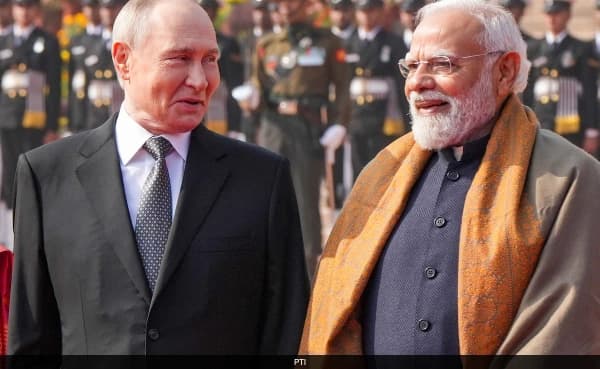
Russian President Vladimir Putin’s visit to India on December 4–5 for the India–Russia Annual Summit drew global attention, though for differing reasons. While the visit was significant for India, Western countries—having largely isolated Mr. Putin since the outbreak of the Ukraine conflict in 2022—watched closely to assess whether the engagement would weaken the diplomatic embargo imposed on him. In navigating this sensitive terrain, New Delhi and Moscow managed the optics with considerable finesse, maintaining India’s strategic autonomy while offering little comfort to Western critics.
A relationship forged over decades
High-level meetings between Indian and Russian leaders have historically been viewed as pivotal moments, often yielding far-reaching consequences. The 1971 India–Soviet Treaty of Peace, Friendship and Cooperation, signed when Indira Gandhi and Leonid Brezhnev led their respective countries, fundamentally reshaped South Asia’s strategic landscape. It enabled India to prevail in the conflict with Pakistan and facilitated the creation of Bangladesh.
Other gestures, though less dramatic, have also underscored Russia’s enduring goodwill towards India. One such example was Mr. Putin’s 2009 decision to waive penalties, allowing India to acquire its second aircraft carrier from Russia. Numerous other instances—many away from public view—have reinforced the personal rapport between the leaderships of the two countries. This mutual trust has long served as the adhesive sustaining the partnership.
Such closeness has frequently unsettled the West, which—despite often aligning with Pakistan and criticising India’s non-aligned posture—interpreted Russia’s support for India as strategically antagonistic.
Following 1971, India–Russia relations entered a new phase, gaining further momentum during the Gorbachev era and solidifying under Mr. Putin’s leadership over the past 25 years. Successive Indian Prime Ministers have continued to nurture this relationship. The Russia–Ukraine war, however, emerged as a critical test. India maintained neutrality and declined to join Western sanctions, a stance that has since generated friction with Western capitals.
Mr. Putin’s latest visit—the first since the West imposed restrictions on his international engagements—was therefore closely scrutinised. A previous interaction between Mr. Putin and Prime Minister Narendra Modi in Tianjin had already drawn Western unease due to the visible warmth between the two leaders.
Reading the Joint Statement
Expectations in the West that shifting global alignments or U.S. trade pressures—particularly punitive tariffs linked to India’s purchase of Russian oil—might dilute India–Russia ties were not borne out. The optics of the Delhi summit suggested continuity rather than recalibration.
The Joint Statement issued after the 23rd India–Russia Annual Summit reaffirmed support for strengthening the “Special and Privileged Strategic Partnership,” marking 25 years since the declaration of strategic partnership. It reiterated the time-tested nature of the relationship, grounded in mutual trust and respect for core national interests, while signalling openness to exploring new areas of cooperation alongside traditional domains.
The symbolism surrounding the visit was striking. Media coverage was extensive, the leaders’ public interactions warm, and emphasis was placed on connectivity initiatives such as the Northern Sea Route through the Arctic and the Chennai–Vladivostok Eastern Maritime Corridor. Technology and industrial collaboration also featured prominently.
Defence: the missing pillar
Notably absent from the Joint Statement, however, was any substantive reference to defence cooperation—a cornerstone of India–Russia relations during the Putin era. Unless this omission reflects a deliberate diplomatic choice to downplay sensitive issues, it may indicate a subtle shift in the relationship’s emphasis. Given that defence cooperation has long been viewed as the bedrock of bilateral ties, its apparent relegation warrants careful scrutiny.
India has diversified its defence acquisitions in recent years, sourcing equipment from countries such as Israel and France. Yet Russia remains India’s most consistent and significant defence partner. It has stood by India during conflicts with Pakistan, often when Western support leaned the other way. Beyond consistency, the quality and strategic importance of Russian defence supplies have been critical to India’s military capabilities.
As demonstrated during Operation Sindoor in May 2025, Russia’s S-400 air and missile defence system—widely credited with bolstering India’s defensive success—along with jointly developed systems such as the BrahMos missile, and platforms including the Sukhoi Su-30 MKI, T-90 tanks, and transport helicopters, remain integral to India’s defence architecture. Progress in joint manufacturing and future collaboration further reinforces this bond.
While India has expanded its procurement options, Russia continues to be its most reliable supplier of advanced weaponry across land, sea and air. A significant pivot towards Western suppliers, especially amid prevailing geopolitical uncertainties, could therefore entail strategic risks. Though such a shift might generate greater Western approval, the costs—both material and strategic—must be weighed carefully, particularly given the West’s historically inconsistent support.
This scepticism is reinforced by recent developments, including the U.S. decision to notify Congress of a $686 million package to modernise Pakistan’s F-16 fleet, following an earlier $400 million upgrade announced in 2025. This comes despite proclamations that U.S.–India relations define the 21st century, highlighting enduring contradictions in Western policy.


